Mathematical Writing - Vivaldi Franco 2014
Wrong Arguments - Examples Versus Proofs
Forms of Argument
In constructing a mathematical argument it’s easy to make mistakes. In this section we identify some common faulty arguments: confusing examples with proofs, assuming what we are supposed to prove, mishandling functions. Other mistakes will be examined in Chap. 9 and in the exercises. Awareness of these problems should help us in avoiding them.
7.7.1 Examples Versus Proofs
The verification of a statement in specific cases does not constitute a form of proof. Our study of Euler’s polynomial in Sect. 7.6 shows how misleading examples can be. This state of affairs is peculiar to mathematics; in other scientific disciplines, such as biology, a proof of a statement consists of independent experimental verifications of its validity.
In our first example the fault is easy to spot.
Theorem. For all primes  , the integer
  is divisible by .
WRONG PROOF.


The theorem has been proved only for  .
.
The next example is similar, but not so clear-cut [36, p. 138f].
Theorem. For all  ,
,  and
and  , if
, if 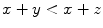 then
then  .
.
WRONG PROOF. Suppose . Take  . Then
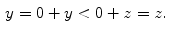
The mistake here is that we took to be  , which is a special value of . This assumption is wholly unjustified, since the quantities
  are controlled by an existential quantifier, and hence no condition may be imposed on them. By adding the assumption that , we have in fact proved the
WEAKER THEOREM. For all and , if 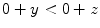 , then .
This is not what we claimed to prove.